
Click here for the Chinese version: 中文
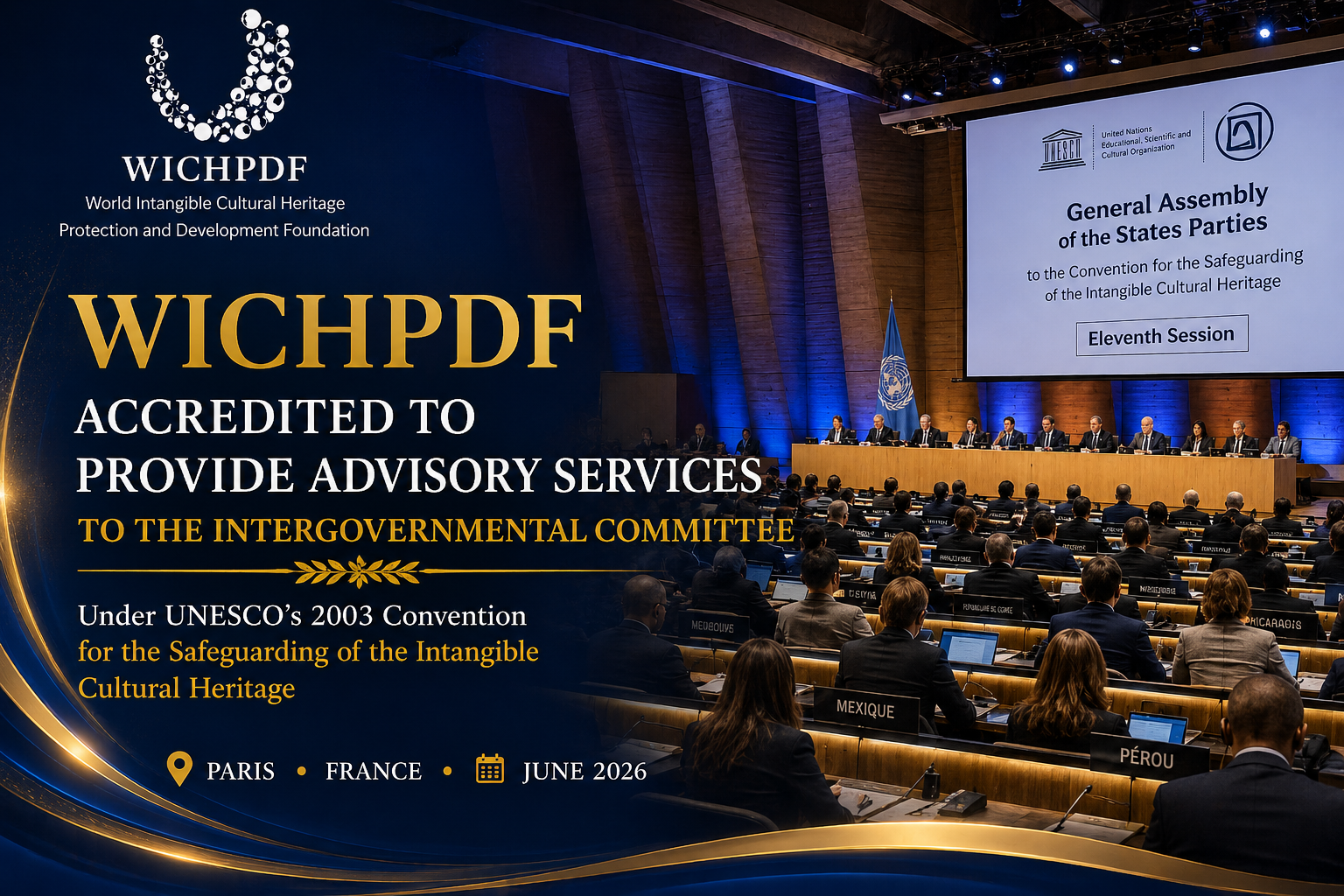
The World Intangible Cultural Heritage Protection and Development Foundation (WICHPDF) is pleased to announce that it has been accredited as a non-governmental organization to act in an advisory capacity to the Intergovernmental Committee for the Safeguarding of the Intangible Cultural Heritage under UNESCO’s 2003 Convention for the Safeguarding of the Intangible Cultural Heritage.
The accreditation was approved by the General Assembly of the States Parties to the Convention during its Eleventh Session LHE/26/11.GA/9. Further details are available in Decision 20.COM 16 concerning the accreditation of new non-governmental organizations. This accreditation recognizes WICHPDF’s expertise, experience, and commitment to safeguarding, preserving, promoting, transmitting, and sustainably developing intangible cultural heritage. Through this status, WICHPDF joins the international network of accredited non-governmental organizations that may provide advisory services and professional expertise in support of the implementation of the Convention.
The Role of Accredited NGOs
Under the Convention, accredited NGOs provide advisory services to the Intergovernmental Committee and contribute specialized expertise regarding the safeguarding of intangible cultural heritage. Accredited organizations support international cooperation, knowledge sharing, capacity building, and the development of effective safeguarding measures that help preserve living heritage for future generations.
As an accredited NGO, WICHPDF may contribute professional knowledge and recommendations concerning the safeguarding of living heritage, including traditional knowledge systems, social practices, traditional medicine, performing arts, traditional sports, and other forms of intangible cultural heritage that strengthen cultural diversity and support sustainable development.
A Milestone for International Cooperation
Obtaining UNESCO accreditation represents an important milestone in WICHPDF’s international development and reflects recognition of the Foundation’s longstanding commitment to safeguarding intangible cultural heritage, promoting intercultural dialogue, and advancing international cooperation.
Building upon its existing Special Consultative Status with the United Nations Economic and Social Council (ECOSOC), WICHPDF will continue to support the objectives of the Convention through education, research, community engagement, cultural exchange, international cooperation, and initiatives aligned with the United Nations Sustainable Development Goals (SDGs).
The Foundation looks forward to working closely with UNESCO, States Parties, accredited organizations, cultural practitioners, academic institutions, and communities worldwide to support the safeguarding and transmission of humanity’s living heritage.
Strategic Priorities for the Future
As an NGO accredited to provide advisory services to the Intergovernmental Committee for the Safeguarding of the Intangible Cultural Heritage, WICHPDF will pursue five strategic priorities consistent with its mission and with the objectives of the 2003 Convention.
1. Building a Global Intangible Cultural Heritage Cooperation Network
Promoting voluntary collaboration among governments, communities, heritage bearers, academic institutions, and civil society organizations, and supporting opportunities for international cooperation and knowledge exchange
2. Advancing Digital Safeguarding and Innovation
Exploring the use of emerging technologies, including artificial intelligence and digital preservation tools, to strengthen the documentation, preservation, research, and dissemination of intangible cultural heritage.
3. Promoting Heritage, Health, and Well-Being
Supporting research, dialogue, and community-based initiatives that explore the cultural contributions of traditional knowledge, traditional healing practices, traditional sports, and living heritage to public well-being and sustainable development.
4. Supporting the United Nations Sustainable Development Goals
Supporting projects and partnerships that contribute to the achievement of:
- SDG 3 – Good Health and Well-Being
- SDG 4 – Quality Education
- SDG 6 – Clean Water and Sanitation
- SDG 11 – Sustainable Cities and Communities
5. Strengthening Intercultural Dialogue and Mutual Learning
Supporting international exchanges, forums, exhibitions, academic research, youth programs, and capacity-building initiatives that foster understanding, respect, and cooperation among cultures.
Looking Ahead
The World Intangible Cultural Heritage Protection and Development Foundation remains committed to its mission of safeguarding cultural heritage, promoting mutual learning among civilizations, and serving the future of humanity.
The Foundation views this UNESCO accreditation as the beginning of a new phase of international engagement. Working together with UNESCO and partners around the world, WICHPDF will continue supporting the principles and objectives of the Convention for the Safeguarding of the Intangible Cultural Heritage, contributing to cultural diversity, international cooperation, and sustainable development for present and future generations.
Representative Inheritor is China’s system of identifying “Living Human Treasures” as proposed by the United Nations Educational, Scientific and Cultural Organization (UNESCO). As defined by UNESCO, “Living Human Treasures are persons who possess to a very high degree the knowledge and skills required for performing or re‐creating specific elements of the intangible cultural heritage. “Each Member State should choose an appropriate title to designate the bearers of knowledge and skills, the title of “Living Human Treasures” proposed by UNESCO being indicative. Among the systems in existence, there are already a variety of titles: Master of Art (France), Bearer of Popular Craft Tradition (Czech Republic), National Living Treasure (Republic of Korea), Holder of an Important Intangible Cultural Property (Japan and Republic of Korea).”
An intangible cultural heritage (ICH) is a practice, representation, expression, knowledge, or skill considered by UNESCO to be part of a place’s cultural heritage. Buildings, historic places, monuments, and artifacts are cultural property. Intangible heritage consists of nonphysical intellectual wealth, such as folklore, customs, beliefs, traditions, knowledge, and language. -Wikipedia
World Intangible Cultural Heritage Protection & Development Foundation is a tax-exempt organization under section 501 C3 of the Internal Revenue Code, EIN No. 35-2625666
We are a USA company